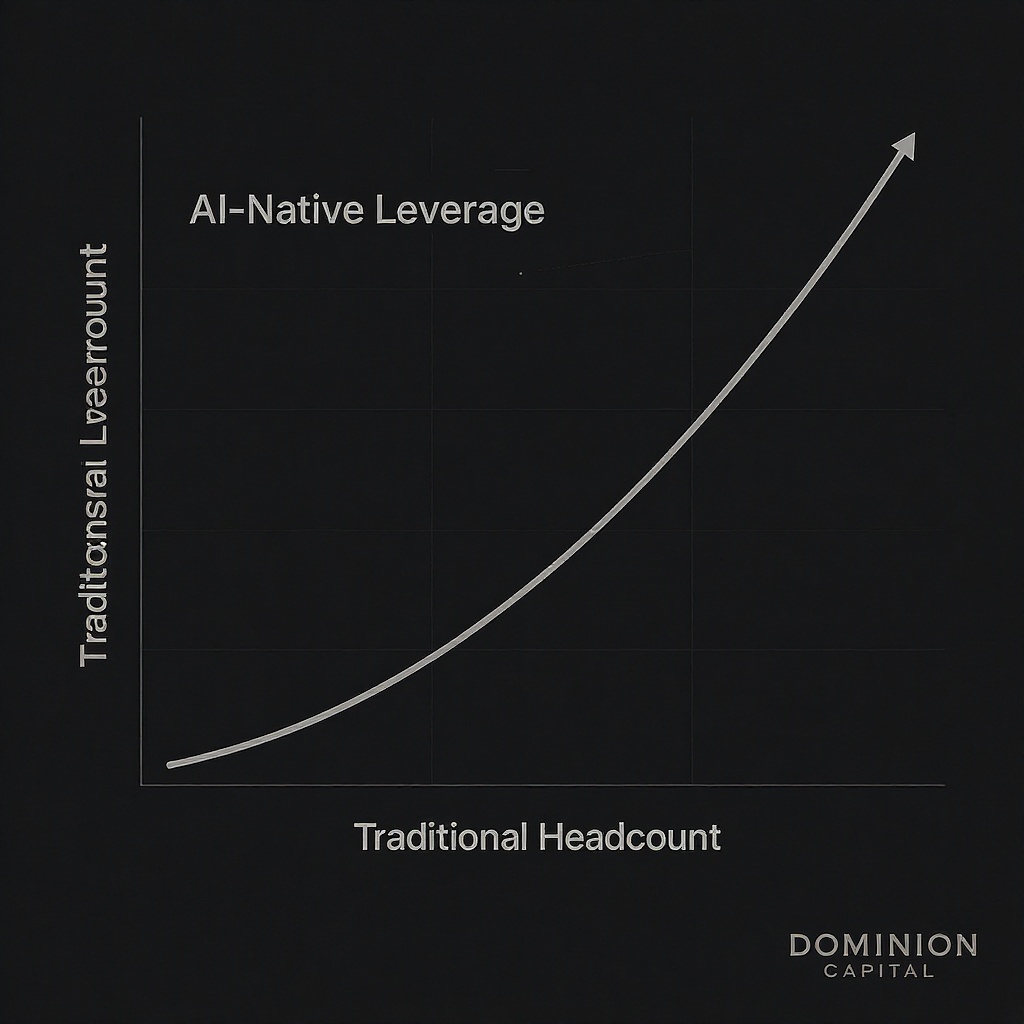
The math on traditional capital groups is simple and brutal: more deals require more analysts, more analysts require more overhead, and overhead eats margin before you've made a single investment decision.
Traditional operating models scale linearly. To review twice as many deals, you hire twice as many people. To manage twice as many portfolio companies, you add another layer of analysts and principals. The ceiling isn't talent — it's headcount, and headcount has a cost structure that doesn't compress.
AI-native operating leverage inverts that curve.
One operator. An always-on agent stack. And the capacity to review more deals, manage more positions, and serve more clients per week than a traditional 10-person team.
That's not a pitch. That's Dominion's current stack.
What "Operating Leverage" Actually Means
Operating leverage in capital allocation has always meant doing more with less — but the mechanism has always been human. LPs funded bigger teams to access more deal flow. The firm's value was its people.
AI-native leverage changes the unit economics entirely.
At Dominion, the agent stack handles:
- Advisory board reasoning depth — When a prospective client submits a transaction structure, the board agent reviews comparable precedents, flags structural risks, and surfaces counterparty concerns in under 60 seconds. The output is structured, not a 30-page deck — it's a ranked brief. A human analyst doing this properly takes half a day.
- Deal screen velocity — The new M&A calculator lets operators run transaction scenarios — purchase price, leverage ratios, exit multiples, IRR under stress — without a spreadsheet or a model. A deal that would take two analysts three days to model gets screened in 90 seconds. You can push more deals through the same pipeline without adding headcount.
- Portfolio monitoring without analyst cost — Weekly position reporting, covenant triggers, and market-moving events are tracked continuously by the portfolio agent. Every portfolio company gets the same monitoring depth. Adding two more positions doesn't require adding staff.
The compounding effect is simple: each new tool makes the entire stack smarter. The operator running deals today is building the infrastructure that will run twice as many deals six months from now.
What This Means for LPs
The LP case is straightforward.
Lower management fee drag. AI-native ops means lower overhead per dollar managed. Fee structures that fund 10-person teams can fund a smaller, sharper operator with better tooling.
Higher decisions-per-dollar. More deal flow gets reviewed at better depth before commitment. The quality of the decision doesn't decrease — the surface area of review expands.
Durable edge as agent capability compounds. Every model update, every new data integration, every workflow automation compounds into the stack. A traditional firm's edge erodes as analysts leave. Dominion's edge erodes only if we stop building.
Risk profile is different. One operator with a superior stack is lower-key but more resilient than a 20-person team with high turnover. There is no team to poach. There is no institutional knowledge walking out the door.
The Decision You're Making When You Allocate
Traditional capital groups ask LPs to fund headcount in exchange for deal flow access. You pay management fees that fund analysts, rent, and infrastructure that scales with your capital.
AI-native operators ask LPs to fund infrastructure in exchange for compounding leverage. You pay management fees that fund tooling, automation, and reasoning depth that scales faster than your capital.
The first model is known. The second is not.
But the second model has one structural advantage that matters more over a 10-year fund life: it gets better without additional capital deployment.
If you're evaluating capital groups for your next allocation, ask one question: "What does your infrastructure look like when you're managing 3x the capital you manage today?"
For traditional firms, the answer is "bigger team, higher overhead, same structural ceiling."
For AI-native operators, the answer is "more signals, faster decisions, lower marginal cost per deal."
That's the edge.
"The first AI-native M&A shop? Or just another fund? Here's why capital allocators should care: AI-native operating leverage gets better as capital compounds — without adding headcount. Your move, LPs."— Joe, Dominion Capital Group Inc.
If you back operators, back the ones whose infrastructure never sleeps.